


In a smartphone-driven economy, mobile apps are no longer just an add-on to an online store - they have become the core of a sales strategy, provided they are properly integrated with marketing and analytics. However, simply having an app does not solve the problem of efficiency. The real challenge lies in acquiring high-value users and measuring their impact on revenue. Without this, an app may generate traffic, but not necessarily business results.
Mobile apps vs mobile web – where is value created?
A key element of any e-commerce strategy is understanding the fundamental differences in user behavior and sales effectiveness between mobile websites and native applications. Although both channels operate on the same device, their role in the conversion funnel is entirely different - and this has a direct impact on performance.
Empirical data clearly shows the advantage of mobile apps in terms of engagement and conversion. Users spend up to 90% of their mobile time in apps. This is not just a matter of preference - it translates directly into business metrics. In practice, apps can achieve up to three times higher conversion rates (CVR) than mobile websites. A deeper look at KPIs reveals the drivers behind this advantage.
Session depth and exploration: Users in apps browse significantly more products during a single session (on average 4.2 times more). Native interfaces are faster and more intuitive, which directly improves product discovery.
Basket value (AOV): App users not only convert more often, but also spend more. In retail apps, the average order value can be 10–50% higher than on mobile web.
Friction reduction: Saved login sessions, stored payment methods, and biometric authentication simplify the checkout process, enabling a “one-tap buy” experience. As a result, cart abandonment rates are lower.
In practice, this means one thing: apps don’t just improve user experience, they have a direct impact on revenue.
Why apps are becoming a market standard
In 2026, having a mobile app is no longer a competitive advantage - it’s a baseline. High-value users increasingly operate within closed environments. Apps reduce distractions and eliminate direct competition, which is always just one tab away in a browser. They also enable access to channels unavailable on mobile web - most notably push notifications, which provide direct communication without media costs. From a business perspective, this means greater control over the customer relationship and their lifetime value.
Mobile analytics - where problems usually start
Implementing analytics in a mobile app is significantly more complex than on the web. In a browser environment, tracking issues can be fixed within minutes (e.g. via Google Tag Manager). In mobile apps, analytics is embedded in the code via SDKs, so any fix requires a new release, app store approval, and time for users to update. In practice, this can create weeks of data gaps.
A lack of precise analytics quickly translates into business impact. Attribution errors can lead to inefficient budget allocation, for example, paying for users who would have installed the app organically anyway. At the same time, teams lose trust in the data, which slows down - or even paralyzes - decision-making. Instead of optimizing campaigns in real time, they spend 40–60% of their time validating reports.
In this context, data quality becomes more important than traffic volume.
From installs to LTV – a shift in approach
In a mature e-commerce market, the number of installs alone is no longer a meaningful success metric - the real measure is the value a user generates over time (LTV – Lifetime Value). That is why analytics must evolve to answer questions about quality, not just quantity:
Which users generate the highest value? (e.g. does a user acquired from a TikTok campaign have higher 30-day retention than one from Google Ads?)
Which channels deliver high-quality traffic? (e.g. what is the install-to-purchase conversion rate?)
Where do users drop off in the purchase journey? (e.g. at what point does churn occur, and can it be prevented?)
Implementing advanced tools such as Amplitude (product analytics) and AppsFlyer (attribution) enables a shift from surface-level analysis to profitability and LTV-driven insights. This marks a fundamental change, where a “growth at all costs” approach gives way to a strategy focused on profitable growth.
Omnichannel challenge
User journeys are rarely linear and often span multiple devices and touchpoints. A typical scenario involves seeing an ad on Instagram on the way to work (mobile), checking product details later on a laptop (desktop), and completing the purchase in the evening on a tablet or returning to mobile. This is no longer an exception - it’s the standard. Without proper data integration, several common issues emerge:
Inaccurate customer acquisition cost (CAC) – the same user is counted multiple times (as a new user on each device), leading to distorted data and incorrect budget allocation decisions.
Inefficient retargeting – a user who has already completed a purchase on desktop continues to be targeted with ads for the same product on mobile, wasting budget, frustrating the user, and negatively impacting brand perception.
Incorrect conversion attribution – desktop conversions are often assigned to “Direct” or “Organic,” while the actual driver was a paid mobile campaign. Without a cross-device view, marketers may mistakenly turn off effective mobile campaigns.
The solution to data fragmentation is implementing a Single Customer View, based on a unique and persistent user identifier (e.g. User-ID). In practice, this most often relies on a deterministic approach to data stitching.
The deterministic approach is considered the gold standard in analytics. It is based on hard login data (such as email address, phone number, or a unique customer ID from a CRM system). When a user logs in on both mobile and desktop using the same account, analytics tools like Amplitude, Firebase, or Google Analytics 360 can deterministically link these sessions into a single, consistent user journey. This is the most accurate method and is recommended by experts at Salestube as the foundation of a data strategy.
Implementing User-ID across tools such as Firebase, AppsFlyer, and Amplitude is a critical technical step. It enables not only accurate analytics, but also advanced personalization - such as sending a push notification to a user’s phone about a cart abandoned on desktop.
Unlock the full potential of your app
At Salestube, we take an integration-first approach. We combine the capabilities of Firebase, AppsFlyer, and Amplitude into one cohesive ecosystem - allowing you to evaluate your app not just through data, but through real business performance.
What should the tech stack look like?
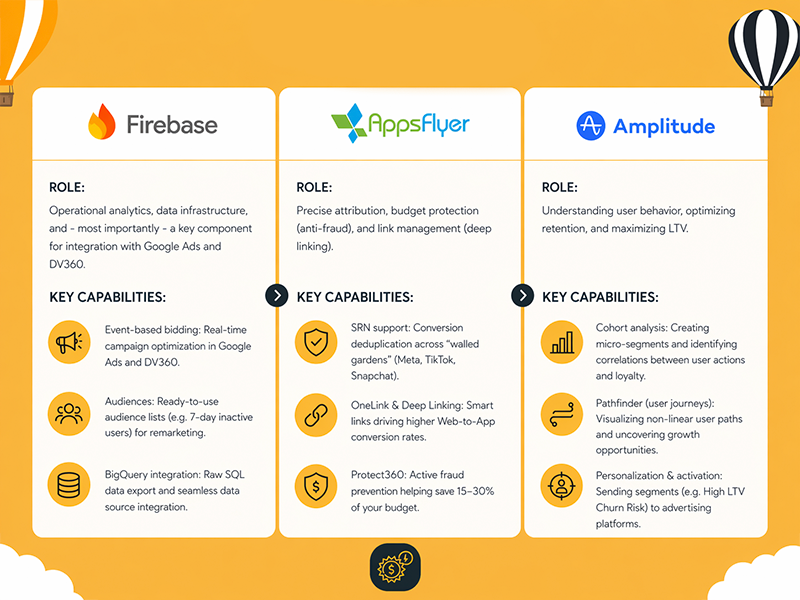
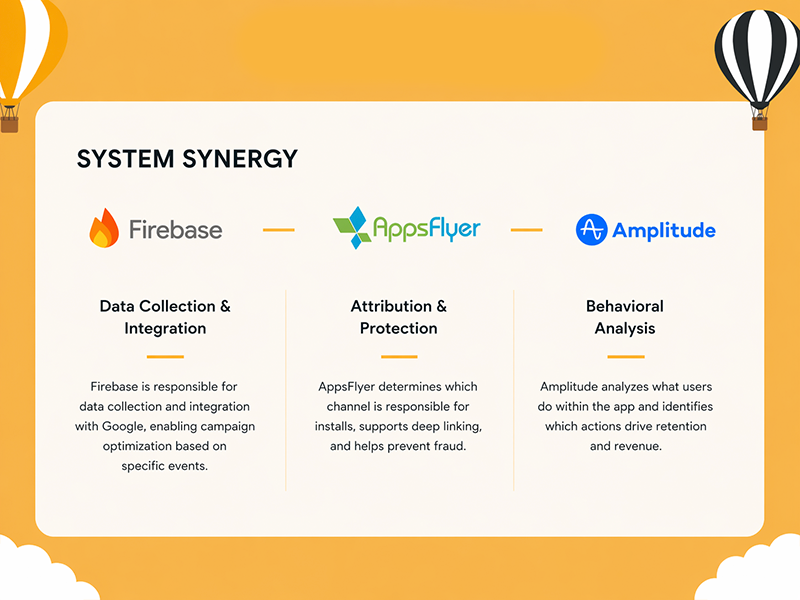
Effective app analytics relies on combining several tools that serve different functions. Firebase is responsible for data collection and integration with the Google ecosystem, enabling campaign optimization based on specific in-app events. AppsFlyer acts as the attribution layer, helping determine which channel actually drives an install or conversion, while also supporting deep linking and fraud prevention. Amplitude complements this ecosystem with behavioral analytics, making it possible to understand what users do in the app and which actions translate into retention and revenue. Only by combining these three perspectives can you gain a complete view of performance.
What should you do?
In 2026, success in e-commerce will belong to organizations that move from simply “having an app” to actively managing mobile customer value.
Recommendations:
Implement User-ID and ensure consistent user identification across platforms.
Use an attribution tool when scaling paid media.
Adopt deep linking in marketing communication.
Shift KPIs from installs to LTV and retention.
Regularly validate data quality.
These actions have a direct impact on budget efficiency and the ability to scale revenue.
From our perspective at Salestube, precise measurement is not only the foundation of a mobile strategy, but of the entire decision-making system - enabling better business decisions instead of relying on intuition. If you want to understand how your app translates into revenue and where you’re losing user value, let’s talk!
'%3e%3cpath%20d='M12.0712%205.87001L45.6719%2016.8181L13.7984%2020.4706L12.0712%205.87001Z'%20fill='%232A87DF'/%3e%3cpath%20d='M15.5232%2035.0719L45.6719%2016.8181L13.7985%2020.4706L15.5232%2035.0719Z'%20fill='%232A87DF'/%3e%3cpath%20d='M13.2906%2016.1663L10.5489%2020.8428L13.8004%2020.4706L13.2906%2016.1663Z'%20fill='%23ED1C24'/%3e%3cpath%20d='M13.7985%2020.4705L14.3057%2024.7755L10.547%2020.8428'%20fill='%23ED1C24'/%3e%3cpath%20d='M45.6735%2016.8181L13.2903%2016.1663L10.5486%2020.8428L45.6735%2016.8181Z'%20fill='%231F5F96'/%3e%3cpath%20d='M45.6735%2016.8181L14.3072%2024.7755L10.5486%2020.8428L45.6735%2016.8181Z'%20fill='%233566C0'/%3e%3c/g%3e%3cdefs%3e%3cclipPath%20id='clip0_1746_13129'%3e%3crect%20width='34.6962'%20height='30.5797'%20fill='white'%20transform='translate(15.3242)%20rotate(28.9945)'/%3e%3c/clipPath%3e%3c/defs%3e%3c/svg%3e)
'%3e%3cpath%20d='M11.5674%2011.6151L74.4339%2016.0111L20.8238%2036.2316L11.5674%2011.6151Z'%20fill='%23FFB901'/%3e%3cpath%20d='M30.0747%2060.8505L74.4325%2016.0111L20.8224%2036.2317L30.0747%2060.8505Z'%20fill='%23FFB901'/%3e%3cpath%20d='M18.0934%2028.9749L15.354%2038.2938L20.823%2036.2317L18.0934%2028.9749Z'%20fill='white'/%3e%3cpath%20d='M20.8254%2036.2316L23.5511%2043.4907L15.3564%2038.2937'%20fill='white'/%3e%3cpath%20d='M74.4337%2016.0111L18.094%2028.9749L15.3546%2038.2938L74.4337%2016.0111Z'%20fill='%23CA9200'/%3e%3cpath%20d='M74.4337%2016.0111L23.5493%2043.4907L15.3546%2038.2938L74.4337%2016.0111Z'%20fill='%23DEA100'/%3e%3c/g%3e%3cdefs%3e%3cclipPath%20id='clip0_1746_13099'%3e%3crect%20width='61.8621'%20height='54.7921'%20fill='white'%20transform='translate(14.6797)%20rotate(15)'/%3e%3c/clipPath%3e%3c/defs%3e%3c/svg%3e)

'%3e%3cpath%20d='M21.2539%2011.4723C21.2539%2017.1352%2016.6629%2021.7262%2011%2021.7262C5.3371%2021.7262%200.746094%2017.1352%200.746094%2011.4723C0.746094%205.80939%205.3371%201.21838%2011%201.21838C16.6629%201.21838%2021.2539%205.80939%2021.2539%2011.4723Z'%20fill='white'/%3e%3cpath%20d='M17.1273%2012.2972V16.5249H14.6765V12.581C14.6765%2011.5903%2014.3231%2010.9138%2013.435%2010.9138C12.7585%2010.9138%2012.356%2011.3699%2012.1784%2011.8108C12.1132%2011.9679%2012.0972%2012.1865%2012.0972%2012.4079V16.5249H9.64549C9.64549%2016.5249%209.6785%209.8446%209.64549%209.15304H12.0972V10.198C12.0927%2010.2061%2012.0856%2010.214%2012.0811%2010.222H12.0972V10.198C12.4229%209.69654%2013.0039%208.97979%2014.3061%208.97979C15.9189%208.97979%2017.1273%2010.0338%2017.1273%2012.2972ZM7.08226%205.59985C6.24328%205.59985%205.69531%206.15053%205.69531%206.87347C5.69531%207.5812%206.22724%208.14696%207.05014%208.14696H7.06532C7.92033%208.14696%208.45226%207.58124%208.45226%206.87347C8.43618%206.15057%207.92033%205.59985%207.08226%205.59985ZM5.8408%2016.5249H8.2907V9.15304H5.8408V16.5249Z'%20fill='%233579B0'/%3e%3c/g%3e%3cdefs%3e%3cclipPath%20id='clip0_1830_427'%3e%3crect%20width='21'%20height='21'%20fill='white'%20transform='translate(0.5%200.936218)'/%3e%3c/clipPath%3e%3c/defs%3e%3c/svg%3e)